
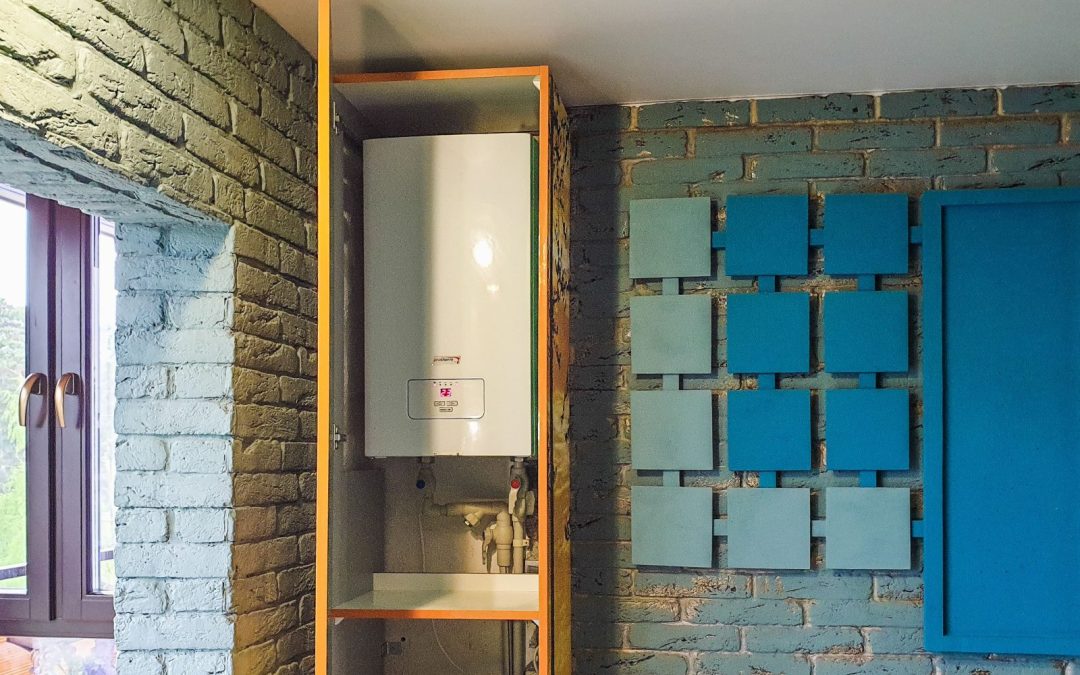
For nearly a century, natural gas has been the fuel that has been at the heart of heating systems in the vast majority of British homes, and installations of new efficient boilers continue to this day.
The main reason for this is that natural gas is one of the most versatile fossil fuels, able to provide high amounts of energy and heat without losing too much energy through inefficiency whilst also being cleaner than alternatives such as coal and wood.
This would ultimately be the reason that natural gas was widely adopted in Britain in the 1940s, as it allowed for the convenience of the boiler and the comfort of the fireplace without the smog that came from coal or town gas.
However, whilst this was the breakthrough moment, it was far from the first time that people would see the potential of natural gas, as the first makeshift gas boiler was constructed over 230 years ago as part of the first house ever heated with natural gas.
This one-of-a-kind experiment of a home would slowly set the wheels in motion for a heating revolution, but to explain why it affects you today, it is worth explaining why it took so long for natural gas to see wide use and why it remains the most popular source of heating to this day.
Who First Used Natural Gas For Heating?
The first ever accounts of natural gas were so shocking that they led to rumours of monsters or a mountain of fire.
The legend of Mount Chimaera, its undying fires and the mythical fire-breathing beast that shares its name are all believed to have been the result of geysers of natural gas that broke the surface of the earth and caused long-lasting fire.
The Oracle of Delphi used a similar naturally occurring natural gas spring for divination purposes.
Other similar phenomena, such as the fires of Lake Erie and the Cuyahoga River in Ohio, are credited to natural gas seeps in the area, ones that were used for both practical and spiritual processes.
Part of this explains our love for a gas fire and why it has been so impossible to replace. However, natural gas was also used for heating, with even a primitive example of the pipelines that power your boiler today.
The Earliest Practical Gas Heater
The first practical use of natural gas for heating was over 2000 years ahead of its time; the Ziliujing District of Sichuan, China, used natural gas to boil brine to extract salts, the first time natural gas was used in an industrial process and the first time a pipeline was used.
It was not perfect; the pipe itself was made of hollowed-out bamboo, which was nowhere near as reliable as a conventional system used today and fitted by a Gas Safe engineer, but
However, the utilisation of natural gas stalled around 500 BC, and would not really take off again in earnest until the late 18th century, when a Scottish inventor living in Cornwall would start to experiment.
Who Owned The First House Heated With Natural Gas?
Whilst it was well established that natural gas caught fire, burned brightly and gave off considerable heat relative to the volume of gas used before the 1790s, it was William Murdoch who provided the breakthrough that changed heating as we knew it forever.
Who Was William Murdoch?
A polymath who excelled in steam engineering and experimented with coal gas from an early age, Mr Murdoch would make several breakthroughs in the development of the steam engine before he reached the age of 25.
He developed a wide range of inventions in this regard, from improved steam locomotives to three-wheeled road vehicles that could be considered amongst the first motor cars ever made.
However, the most important invention that he was credited for was the development of gas lighting, to replace the lanterns fueled by oil and tallow that were widely used at the time.
The Murdoch House
Mr Murdoch initially experimented with the creation and use of natural gas in a local cave near Redruth, his home for over a decade whilst he lived in Cornwall.
By 1792, he felt confident enough to try his experiments at home, and in his house/workshop in Redruth, he would begin to change heating as we know it today.
His initial experiments focused on producing town gas, which would be piped through a retort into an old gun barrel, where it would be ignited.
He tirelessly explored different methods to produce gas using different substances, analysed quality and quantity and explored potential ways to create an infrastructure system for distributing gas in quantities sufficient enough for it to be of practical use.
To What Extent Did William Murdoch Use Natural Gas In His Home?
He both lit and heated his home using this gas as part of the experiment, although exactly how and to what extent he relied on gas as his primary source of heating still remains.
Given the importance of safety when handling gas boilers, to the point that only engineers on the Gas Safe Register are legally allowed to work on them, one questions exactly how much he heated his home using natural gas.
The early systems may have led to the risk of poisoning, accidental combustion and filling his living quarters with the relatively strong odour of burning coals.
This suggests that, whilst it is likely to have been used, the Murdoch House in Redruth did not permanently have natural gas heating, although his system helped to inspire its widespread adoption over the following century.
However, he was the first to use a makeshift portable gas lantern by filling up a bladder with gas, placing a tobacco pipe into the bladder and gradually discharging a stream of natural gas which helped provide a safety light in winter.
By the end of the decade, Mr Murdoch left the pioneering original house and moved to Birmingham, where he would start to experiment with lighting the Soho foundry using natural gas.
However, he never received a patent for his innovation, partly on the recommendation of James Watt Jr, who suggested that there was no market for it.
This proved to be extremely wrong, extremely quickly.
How Did Gas Heating And Lighting Become Widespread?
Boulton and Watt, Mr Murdoch’s employers, limited their aspirations in the gas heating and lighting space to factories and mills, believing that domestic and street lighting would never sell.
Samuel Clegg and Friedrich Winzer both disagreed and would be rewarded handsomely for it.
By the early 19th century, gas heating and lighting had transformed Britain, kickstarted the Industrial Revolution and would eventually lead to the widespread use of natural gas fires and boilers to provide heating, lighting and warm water.
More advanced boilers that were part of the rapid development of steam engines would form the basis of a modern central heating system.
Why Is Natural Gas Heating Still Used In Your Home Today?
Much of this infrastructure continues to be used today, and many older homes are designed with boilers in mind, which is part of the reason why there is still considerable value in keeping your boiler rather than switching to a heat pump.
Many homes are designed specifically with gas boilers in mind, making any transition more expensive than you may expect, given how many modifications you would need to make to your home’s insulation and draughtproofing to make it worthwhile.
Ultimately, your current boiler and your next boiler will continue to provide a lifetime of efficient service, and a small portion of the credit should go to the first inventor to see the potential of natural gas.