
If you have gas underfloor heating installed, you will know about its many benefits, from energy efficiency to lower bills and consistent warmth.
According to government statistics released in 2021, 1.4 per cent of UK homes had underfloor heating installed, and the market is growing, particularly for new homes.
But with all the pipework hidden from sight, how do you know when something isn’t quite right with your underfloor heating? And how do you know when it is time to call a heating engineer for a service and maintenance check?
How do gas underfloor heating systems work?
There are two different types of underfloor heating commonly installed in the UK. An electric underfloor system or a gas underfloor heating, also known as a wet system.
A wet system works in a similar way to using a gas boiler with radiators. The key difference is that it distributes the hot water through a network of pipes hidden beneath a hard floor of concrete or screed.
The floor then radiates heat throughout the room and is warm to walk on, even without slippers or fluffy socks.
The system can regulate temperature in different rooms using thermostatic probes and flow rates, making it a very efficient and economical way to heat your home.
How to check if your gas underfloor heating is working properly
There are advanced checks that should be done by a gas heating engineer, but here are a few that you can do yourself. Remember, if you aren’t sure, it is best to call an expert.
Check for heat
Probably your first indication that something is wrong is the lack of heat felt through the floor. It can take six to eight hours for underfloor heating to reach the correct temperature, so switch it on and wait.
It is best to check the temperature in multiple rooms and locations to see if the heat is even or if there are cold patches.
After each of the checks below, wait and feel for heat again. An easy way to do this is by placing soft furnishings on the floor – perhaps a towel or cushion – and checking if it is warm later.
Check the power supply
Make sure that the power supply hasn’t tripped the circuit breaker board and that it is still receiving electricity.
Check that the thermostat is turned up
If a system is switched on, there is usually a symbol or indicator light on the display. Check for this and then turn the thermostat up slightly higher than you would normally so that it calls for heat.
Check that the actuators are rising
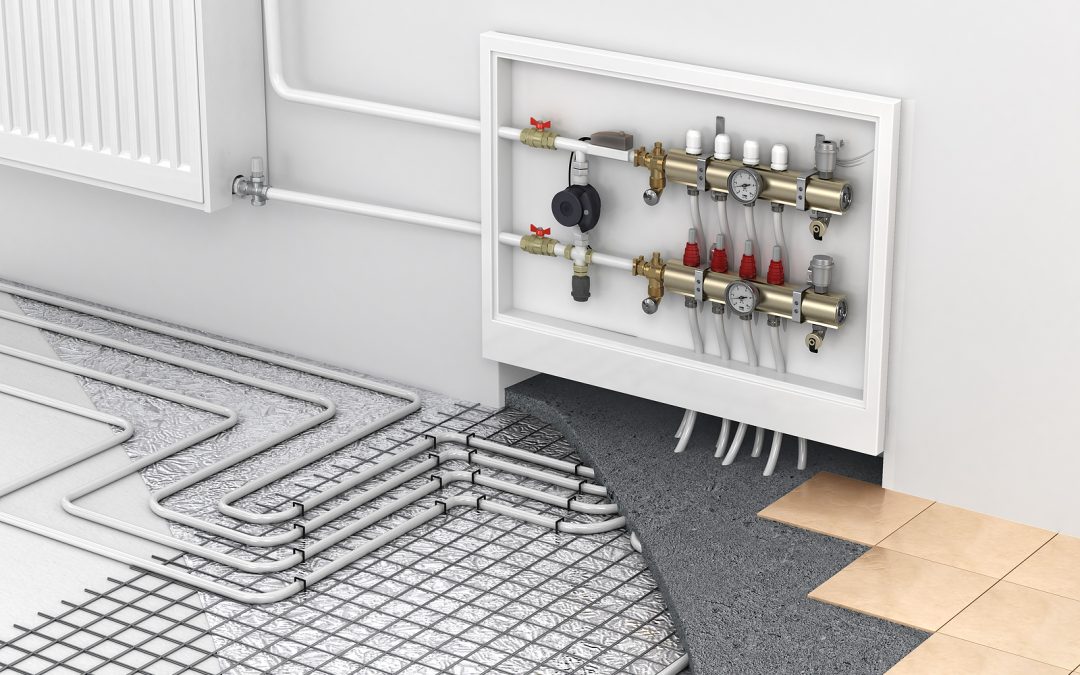
If the thermostat is up, the system will be calling for heat, and the actuators should open. You will usually find these on the top of the manifold next to the boiler where the water is distributed from.
The ring or pin – usually brightly coloured – will be pushed up when they have power, showing that they are open.
Check the manifold
The manifold is the part of the system that manages the flow of water. It ensures the heat gets to the right place.
It will have a gauge display that shows the rate of water and levers to adjust it. A system needs to be properly balanced to function efficiently and deliver even heat distribution throughout your home.
A low flow rate or zero flow suggests that something needs adjusting or repairing. If you are not confident about adjusting the flow to different sections, it is safer to leave it to a heating engineer.
Check the flow and return pipes
The pipe that takes hot water underneath the floor should be hot, and the one that returns it to the boiler should be slightly cooler. If both pipes are only lukewarm or if they are both cold, then something is not working correctly.
Check for strange noises
If you can hear gurgling noises in the pipes when the system is functioning, there may be an airlock in the system.
How easy are gas underfloor heating systems to repair?
The ease of repair for a gas underfloor heating system will largely depend on which part is in need of fixing.
The good news is that most common issues are easily repaired by a qualified heating engineer. These are problems with faulty thermostats, the water distribution at the manifold, flow rates and damaged sensors.
The most complex to fix are those where the problem is underneath the floor. These are usually caused by errors when installing the system. Included in these are leaking pipes and issues with temperature probes and electrical cables.
However, an experienced professional will be able to diagnose the issue, lift the required area of floor and repair it.
If you are experiencing difficulties with your gas-powered underfloor heating, call our engineers at South Thames Gas to take a look.
We’ll diagnose the issue and get your underfloor heating functioning efficiently again.